

Ruud Gullit: The Black Tulip Who Revolutionized AC Milan
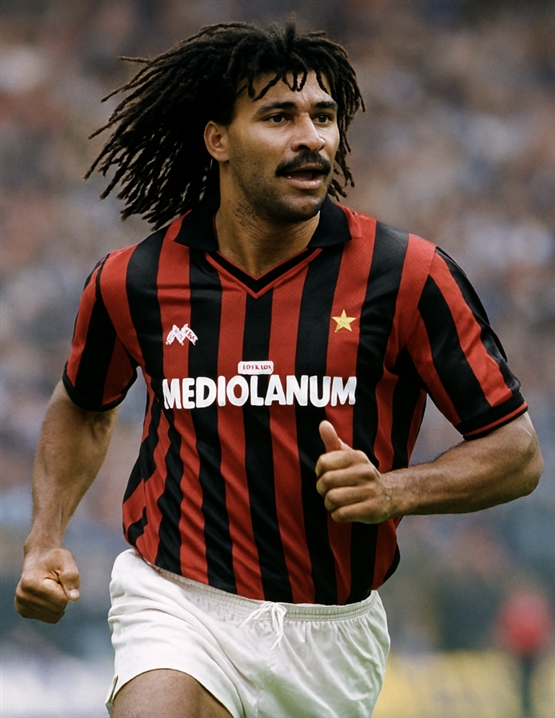
Ruud Gullit arrived at AC Milan in 1987 for a then-world record transfer fee (£6 million) and immediately became the catalyst for the “Immortals” era under Arrigo Sacchi. Combining unparalleled athleticism with immense technical skill, the Dutch superstar led Milan to their first Scudetto in nine years (1988) and back-to-back European Cup victories (1989, 1990). As the winner of the 1987 Ballon d’Or, Gullit formed the legendary “Dutch Trio” alongside Marco van Basten and Frank Rijkaard, redefining the role of a modern playmaker and cementing his legacy as one of the greatest players in Rossoneri history.
Table of Contents
- Arrival in Milan (1987)
- The World Record Fee
- Silvio Berlusconi’s Vision
- Arrigo Sacchi’s Revolution
- The 1987 Ballon d’Or Victory
- Debut Season Impact
- The Scudetto of 1988
- The Dutch Trio Formation
- Relationship with Van Basten
- Frank Rijkaard’s Arrival
- Tactical Role: Total Footballer
- Physical Dominance
- The Iconic Dreadlocks
- 1989 European Cup Final
- Goals vs Steaua Bucharest
- 1990 European Cup Triumph
- Rivalry with Maradona’s Napoli
- The “Black Tulip” Nickname
- Knee Injury Struggles
- Comeback King
- Milan vs Real Madrid 5-0
- Leadership as a Captain
- Life in Milan: The Celebrity
- Cultural Impact in Italy
- Relationship with Sacchi
- Transition to Capello Era
- The Invincibles (1991-92)
- Versatility on the Pitch
- Free Kick Specialist
- Aerial Threat
- Departure to Sampdoria (1993)
- The Revenge Season (Sampdoria)
- Return to Milan (1994)
- Final Departure to Chelsea
- Comparison with Maradona
- Comparison with Platini
- The “Immortals” Legacy
- San Siro Atmosphere
- Gullit’s Best Goals for Milan
- Influence on Modern Midfielders
- Statistics: 1987-1993
- European Super Cup Success
- Intercontinental Cup Glory
- Italian Super Cup Victories
- Relationship with Curva Sud
- Post-Football Connection to Milan
- AC Milan Hall of Fame
- Gullit on Beating Inter Milan
- The End of an Era
- Ruud Gullit Today
Arrival in Milan (1987)
In the summer of 1987, Ruud Gullit arrived at Milanello from PSV Eindhoven. His signing signaled Milan’s intent to return to the summit of world football after years of mediocrity.
| Event | Detail |
|---|---|
| Year | 1987 |
| From | PSV Eindhoven |
The World Record Fee
Silvio Berlusconi paid a then-world record fee of roughly £6 million (13.5 billion Lire) to secure Gullit. This smashed the previous record held by Diego Maradona.
| Record | Amount |
|---|---|
| Fee | £6 Million (approx) |
| Previous Holder | Maradona |
📍 Location: Milan HQ (Via Turati)
Silvio Berlusconi’s Vision
Berlusconi wanted a player who embodied power, charisma, and skill to be the face of his new Milan. Gullit was the chosen one to lead the revolution against Juventus and Napoli.
| President | Vision |
|---|---|
| Berlusconi | Spectacular Football |
| Symbol | Ruud Gullit |
Arrigo Sacchi’s Revolution
New manager Arrigo Sacchi found in Gullit the perfect “Total Footballer” to execute his high-pressing, zonal-marking system. Gullit could play anywhere and dominate.
| Coach | Style |
|---|---|
| Sacchi | Pressing & Zone |
| Key Player | Gullit |
The 1987 Ballon d’Or Victory
Just months after joining Milan, Gullit was awarded the Ballon d’Or as Europe’s best player, dedicating the award to Nelson Mandela, showcasing his strong character off the pitch.
| Award | Year |
|---|---|
| Ballon d’Or | 1987 |
| Dedication | Nelson Mandela |
Debut Season Impact
With Van Basten injured for most of the season, Gullit carried the team on his shoulders. His power and pace were unlike anything Serie A defenders had seen before.
| Season | Role |
|---|---|
| 1987-88 | Leader |
| Performance | Dominant |
The Scudetto of 1988
Milan won their 11th Scudetto, their first since 1979. Gullit’s performance in the decisive match against Maradona’s Napoli at the San Paolo (now Maradona Stadium) was legendary.
| Trophy | Year |
|---|---|
| Scudetto | 1988 |
| Rival | Napoli |
The Dutch Trio Formation
The arrival of Rijkaard in 1988 completed the triumvirate. Gullit (Power), Van Basten (Elegance), and Rijkaard (Balance) formed the greatest foreign trio in Serie A history.
| Members | Role |
|---|---|
| Gullit | The Power |
| Van Basten | The Finisher |
| Rijkaard | The Anchor |
Relationship with Van Basten
Though they had different personalities, on the pitch they were telepathic. Gullit often played deeper or as a second striker to feed Van Basten’s insatiable appetite for goals.
| Partner | Dynamic |
|---|---|
| Van Basten | Telepathic |
| Success | Euro 88 & Milan |
Frank Rijkaard’s Arrival
Gullit strongly advocated for Milan to sign his childhood friend Rijkaard. Their connection provided the spine of the Milan team that conquered Europe.
| Friend | Impact |
|---|---|
| Rijkaard | Midfield Steel |
| Connection | Childhood Friends |
Tactical Role: Total Footballer
Gullit defied traditional positions. He started as a right-sided forward, played as a #10, and often dropped deep. He was described as a “player from the future” in the 80s.
| Position | Style |
|---|---|
| Versatile | Total Football |
| Trait | Box-to-Box Power |
Physical Dominance
Standing 1.90m tall with sprinter speed, Gullit physically overwhelmed Italian defenders who were used to slower, technical playmakers.
| Attribute | Advantage |
|---|---|
| Height | 1.90m |
| Speed | Explosive |
The Iconic Dreadlocks
His hairstyle became a global brand. The sight of Gullit’s dreadlocks bouncing as he ran past defenders remains one of the most iconic images in football history.
| Look | Iconic Status |
|---|---|
| Dreadlocks | Global Brand |
| Nickname | The Black Tulip |
1989 European Cup Final
Often cited as the greatest performance by a club team. Milan destroyed Steaua Bucharest 4-0 at Camp Nou. Gullit was unstoppable, scoring two goals.
| Match | Score |
|---|---|
| Milan vs Steaua | 4-0 |
| Venue | Camp Nou |
Goals vs Steaua Bucharest
Gullit scored the opening goal (a tap-in) and the third goal (a thunderous volley). He dedicated the victory to the Milan fans who invaded Barcelona.
| Stats | Match |
|---|---|
| Goals | 2 |
| Result | Champion |
1990 European Cup Triumph
Milan defended their title against Benfica in Vienna (1-0). While Rijkaard scored the winner, Gullit’s presence (returning from injury) boosted the team’s morale significantly.
| Match | Score |
|---|---|
| Milan vs Benfica | 1-0 |
| Venue | Vienna |
Rivalry with Maradona’s Napoli
The late 80s Serie A was defined by Milan vs Napoli, Gullit vs Maradona. It was a clash of the titans, with both players having immense mutual respect.
| Rivalry | Key Players |
|---|---|
| North vs South | Milan vs Napoli |
| Star Duel | Gullit vs Maradona |
The “Black Tulip” Nickname
A nickname given by the Italian press, symbolizing his Dutch heritage (Tulip) and his unique presence. It became synonymous with elegance and power.
| Nickname | Meaning |
|---|---|
| Black Tulip | Dutch Heritage & Grace |
| Origin | Italian Media |
Knee Injury Struggles
Gullit’s career at Milan was plagued by knee injuries (meniscus). He underwent multiple surgeries, which limited his playing time in the 1989-90 and 1990-91 seasons.
| Challenge | Impact |
|---|---|
| Right Knee | Chronic Issues |
| Resilience | Always Returned |
📍 Location: Milanello Treatment Room
Comeback King
Despite doctors fearing for his career, Gullit always returned with the same explosiveness. His ability to reinvent himself post-injury was remarkable.
| Trait | Result |
|---|---|
| Mental Strength | High |
| Return | Key for Finals |
Milan vs Real Madrid 5-0
The 1989 semi-final demolition of Real Madrid is considered the peak of Sacchi’s Milan. Gullit scored a header in this match, which signaled the end of Madrid’s “Quinta del Buitre” era.
| Match | Score |
|---|---|
| Milan vs Real | 5-0 |
| Gullit | Scorer |
Leadership as a Captain
While Baresi was the club captain, Gullit was a technical leader on the pitch. His presence demanded excellence from teammates, and he often took charge when the team needed a spark.
| Role | Style |
|---|---|
| Leader | Vocal & Technical |
| Influence | Global |
Life in Milan: The Celebrity
Gullit embraced the Milanese lifestyle. He was a superstar off the pitch, involved in music (releasing songs) and TV, embodying the modern celebrity footballer.
| Lifestyle | Status |
|---|---|
| City | Milan |
| Fame | Superstar |
Cultural Impact in Italy
He broke barriers and became a beloved figure not just for Milan fans but across Italy. He represented a new, cosmopolitan Italy in the late 80s.
| Impact | Scope |
|---|---|
| Cultural | Icon |
| Popularity | Immense |
Relationship with Sacchi
It wasn’t always smooth. Gullit and Sacchi often clashed over tactics and training intensity. Gullit once famously said, “We won despite Sacchi,” though he later acknowledged the coach’s genius.
| Relationship | Status |
|---|---|
| Sacchi | Tense but Successful |
| Respect | Grew over time |
Transition to Capello Era
When Capello took over in 1991, Gullit’s role changed. He was moved to the right wing more often. Capello’s pragmatism clashed with Gullit’s desire for freedom, leading to friction.
| Coach | Era |
|---|---|
| Capello | 1991-1996 |
| Role | Right Midfield/Forward |
The Invincibles (1991-92)
Gullit was a key part of the “Invincibles” team that won the Serie A undefeated in 1991-92, although he shared playing time due to the 3-foreigner rule.
| Record | Team |
|---|---|
| Undefeated | Serie A Champions |
| Season | 1991-92 |
Versatility on the Pitch
Sweeper, midfielder, winger, striker. Gullit could play them all at a world-class level. This versatility was his greatest weapon and sometimes his burden.
| Positions | Ability |
|---|---|
| Multiple | World Class |
| Asset | Complete Player |
Free Kick Specialist
Often overshadowed by his power, Gullit possessed a delicate touch on set pieces, scoring numerous free kicks for Milan with precision.
| Skill | Type |
|---|---|
| Set Pieces | Accurate |
| Goals | Many |
Aerial Threat
His header against Real Madrid and Steaua showcased his aerial dominance. Few defenders could outjump Gullit in the box.
| Attribute | Rating |
|---|---|
| Heading | Elite |
| Threat | Set Pieces/Crosses |
Departure to Sampdoria (1993)
Frustrated by Capello’s rotation policy (due to the foreigner limit), Gullit left Milan for Sampdoria in 1993, aiming to prove he was not “finished.”
| Event | Move |
|---|---|
| From | Milan |
| To | Sampdoria |
The Revenge Season (Sampdoria)
Gullit had an incredible season at Sampdoria, scoring 15 goals. He famously scored the winner against Milan and refused to celebrate, while looking pointedly at the Milan bench.
| Season | Revenge |
|---|---|
| Performance | Stellar |
| Moment | Goal vs Milan |
Return to Milan (1994)
Impressed by his renaissance, Berlusconi re-signed Gullit in 1994. However, the magic wasn’t quite the same, and the relationship with Capello remained strained.
| Event | Outcome |
|---|---|
| Return | 1994 |
| Duration | Short-lived |
Final Departure to Chelsea
Gullit left Italy for good in 1995 to join Chelsea, marking the end of his glorious Serie A chapter. He brought “Sexy Football” to England.
| Move | Destination |
|---|---|
| From | Milan/Samp |
| To | Chelsea (Premier League) |
Comparison with Maradona
While Maradona was pure individual genius, Gullit was the ultimate team athlete. Milan beat Napoli because Gullit integrated into a system better than Diego.
| Gullit | Maradona |
|---|---|
| Physical/System | Individual/Skill |
| Milan Era | Napoli Era |
Comparison with Platini
Gullit succeeded Platini as the King of Serie A. Platini was the cerebral #10 of the early 80s; Gullit was the dynamic “Total Player” of the late 80s.
| Platini | Gullit |
|---|---|
| The Past (Juve) | The Future (Milan) |
| Style | Different Eras |
The “Immortals” Legacy
Gullit was the heartbeat of Sacchi’s “Immortals,” a team voted by World Soccer magazine as the greatest club side of all time.
| Team | Status |
|---|---|
| Sacchi’s Milan | The Immortals |
| Gullit | The Heartbeat |
San Siro Atmosphere
The roar when Gullit received the ball at San Siro was unique. He had a special bond with the Curva Sud, who adored his fighting spirit.
| Venue | Atmosphere |
|---|---|
| San Siro | Electric |
| Crowd | Adored Gullit |
Gullit’s Best Goals for Milan
From the header against Real Madrid to the solo runs against Napoli. Gullit’s goal catalog is a mix of power headers, long-range strikes, and individual brilliance.
| Goals | Variety |
|---|---|
| Headers | Power |
| Runs | Speed |
Influence on Modern Midfielders
Gullit was the prototype for the modern athletic attacking midfielder—players like Pogba, Yaya Touré, and Bellingham share DNA with Gullit’s style.
| Legacy | Prototype |
|---|---|
| Style | Power & Technique |
| Modern | Pogba/Bellingham |
Statistics: 1987-1993
While injuries affected his total appearances, his goals-per-game ratio and assist contribution were elite for a midfielder/second striker in the defensive Serie A.
| Games | Goals |
|---|---|
| 171 (approx) | 56 (approx) |
| Trophies | Multiple |
European Super Cup Success
Gullit helped Milan dominate not just the European Cup but also the Super Cup (1989, 1990), cementing their status as the world’s best team.
| Trophy | Years |
|---|---|
| Super Cup | 1989, 1990 |
| Dominance | Continental |
Intercontinental Cup Glory
In Tokyo, Milan became world champions twice. Gullit’s global stardom was evident as Japanese fans flocked to see the Dutch master.
| Trophy | Location |
|---|---|
| Intercontinental | Tokyo |
| Years | 1989, 1990 |
Italian Super Cup Victories
Another piece of silverware in Gullit’s cabinet. Milan’s domestic dominance under Capello ensured they swept all available trophies.
| Trophy | Context |
|---|---|
| Supercoppa | Domestic Dominance |
| Era | Early 90s |
Relationship with Curva Sud
Gullit remains a fan favorite. His chants are still sung, and his return to San Siro always garners a standing ovation from the Curva Sud.
| Fans | Bond |
|---|---|
| Curva Sud | Eternal Love |
| Status | Idol |
Post-Football Connection to Milan
Gullit frequently appears as a pundit and ambassador for Milan. He speaks fondly of his time there, calling it the “highlight of his career.”
| Role | Connection |
|---|---|
| Ambassador | Active |
| Sentiment | Highlight |
AC Milan Hall of Fame
Inducted into the AC Milan Hall of Fame, Gullit is recognized as one of the pillars upon which the modern global brand of AC Milan was built.
| Honor | Status |
|---|---|
| Hall of Fame | Inducted |
| Legacy | Pillar |
Gullit on Beating Inter Milan
Gullit loved the Derby della Madonnina. His physical battles with Inter legends like Bergomi are part of Derby folklore.
| Rivalry | Match |
|---|---|
| Derby | Milan vs Inter |
| Performance | Big Game Player |
The End of an Era
Gullit’s departure, followed by Rijkaard’s exit and Van Basten’s injury, marked the end of the Dutch era in Milan. It remains the golden standard for foreign influence in Calcio.
| Era | End |
|---|---|
| Dutch Trio | Mid-90s |
| Legacy | Golden Standard |
Ruud Gullit Today
Today, Ruud Gullit is a respected football analyst. His insights into the game are valued, and his legend at AC Milan remains untouched by time.
| Current | Role |
|---|---|
| Analyst | TV Pundit |
| Legend | Untouched |
FAQ: Ruud Gullit & AC Milan
When did Ruud Gullit join AC Milan?
Ruud Gullit joined AC Milan in the summer of 1987 from PSV Eindhoven for a then-world record transfer fee.
Did Ruud Gullit win the Ballon d’Or at AC Milan?
Yes, Ruud Gullit won the Ballon d’Or in 1987, shortly after joining AC Milan, recognizing his performances for PSV and his start at Milan.
Who were the other members of the Dutch Trio at AC Milan?
The other members were Marco van Basten (striker) and Frank Rijkaard (midfielder/defender). Together with Gullit, they formed a legendary partnership.
How many European Cups did Gullit win with Milan?
Ruud Gullit won two consecutive European Cups (now Champions League) with AC Milan in 1989 and 1990.
Why did Ruud Gullit leave AC Milan for Sampdoria?
He left in 1993 due to a strained relationship with manager Fabio Capello and the restriction on foreign players (only 3 allowed on the pitch), which led to him being rotated too often.
What was Ruud Gullit’s nickname in Italy?
He was affectionately known as “Il Tulipano Nero” (The Black Tulip) due to his Dutch heritage and Surinamese roots.
Did Ruud Gullit ever return to AC Milan?
Yes, after a successful season at Sampdoria (1993-94), he returned to AC Milan for a brief spell in the 1994-95 season before moving to Chelsea.
What position did Gullit play for Milan?
Gullit was extremely versatile. He played as an attacking midfielder, a second striker, a right winger, and sometimes even deeper in midfield. He described himself as a “Total Footballer.”
How many goals did Gullit score in the 1989 European Cup Final?
Ruud Gullit scored two goals in the 1989 European Cup Final against Steaua Bucharest, helping Milan win 4-0.
Is Ruud Gullit in the AC Milan Hall of Fame?
Yes, Ruud Gullit is an inducted member of the AC Milan Hall of Fame and is widely considered one of the greatest players in the club’s history.
Authoritative References
[2](https://footballmakeshistory.eu/ruud-gullit/)
[3](https://destinationcalcio.com/arrigo-sacchi-reinventing-football-knocking-back-maradona/)
[4](https://fr.wikipedia.org/wiki/Ballon_d’or_1987)
[5](https://www.youtube.com/watch?v=r7zM40gE1GY)
[6](https://www.acmilan.com/en/club/legends/players/gullit)
[7](https://www.thenationalnews.com/sport/football/on-this-day-march-21-1987-ruud-gullit-joins-ac-milan-for-world-record-fee-1.995213)
[8](https://www.facebook.com/mundialstyle/posts/the-great-ac-milan-guided-by-arrigo-sacchifblifestyle/1265482295613814/)
[9](https://en.wikipedia.org/wiki/1987_Ballon_d’Or)
[10](https://www.youtube.com/watch?v=3nAqkTZ8FAA)